
Paul Draus and Juliette Roddy have been involved in street-level sociological research in Detroit for over ten years. Roddy is an economist and a member of the Sault Ste. Marie Tribe of Ojibwe Indians. She studies substance use, recovery and re-entry in the city of Detroit and teaches health policy and health economics in the Health and Human Services Department at the University of Michigan-Dearborn. Draus is professor of sociology at the University of Michigan-Dearborn. His research resides at the intersection of health and urban ethnography, and is especially focused on the life of marginalized populations in post-industrial cities. His research with Juliette Roddy, Mark Greenwald and other co-authors has integrated ethnographic and economic data to examine the everyday lives of Detroit heroin users, street sex workers, and other residents of forsaken neighborhoods.
I invited Paul and Julie to provide a short example of their ethnographic work in Detroit for Understanding Society. Thanks, Paul and Julie!
Scraping Black Bottom: Linking Memory, Identity and Community in Detroit
Paul Draus and Juliette Roddy
We have been traipsing up and down Detroit streets for a number of years, in the course of carrying out various research projects and sometimes just out of curiosity. Like any other city, Detroit reveals more on foot than it does to the casual windshield or media-based observer. This being the Motor City, and the automobile being one of the main vehicles of both its early 20th-century prosperity and its late 20th-century deconstruction, it seems particularly appropriate to abandon one’s car in order to explore the remnants of the city left behind.
We use the word remnant rather than ruin deliberately, to counter the impression that Detroit is abandoned, empty or vacant, that it is simply a blank slate waiting to be rebuilt or reimagined by entrepreneurial newcomers or self-styled urban pioneers. While Detroit’s open spaces and ghostly buildings with their empty eyes do invite one’s imagination to wander, our on the ground encounters and interviews reveal a city that not only still lives, but struggles and asserts itself even more vigorously against the tide of withdrawn resources that has sucked its neighborhoods in a tightening spiral of disinvestment, neglect, escape and despair. These individuals express a powerful sense of pride in what Detroit has been, as well as a belief in its future potential, though tempered by that weary skepticism borne of hard experience and past disappointments.
Here we focus on one mobile interview, with a man we call “Mack,” a lifelong resident of the city’s once vibrant and now desolate-seeming East Side. Theoretically we draw upon the ideas of Deleuze, Guattari, and DeLanda, as well as the concepts of Yi-Fu Tuan, who wrote that, “Space and place are basic components of the lived world; we take them for granted. When we think about them, however, they may assume unexpected meanings and raise questions we have not thought to ask” (Space and Place: The Perspective of Experience, p. 3). The form of this interview was a movement across the landscape, involving the three of us, and a digital recorder. As he led us on a walk through this territory that he knew intimately, we invited him to share whatever thoughts and observations came to mind, while occasionally asking questions to clarify what he said or understand what we were seeing.
This movement and these traces call to mind Deleuze and Guattari’s concept of a line of flight, illustrated in A Thousand Plateaus with the image of a wolf life, which appears as nothing more than a set of tracks across a field of snow. The line of flight represents a departure from regularity, a kind of disruption of fixed status, like a deer leaping over a fence, which contains possibility but also implies a return to regularity.
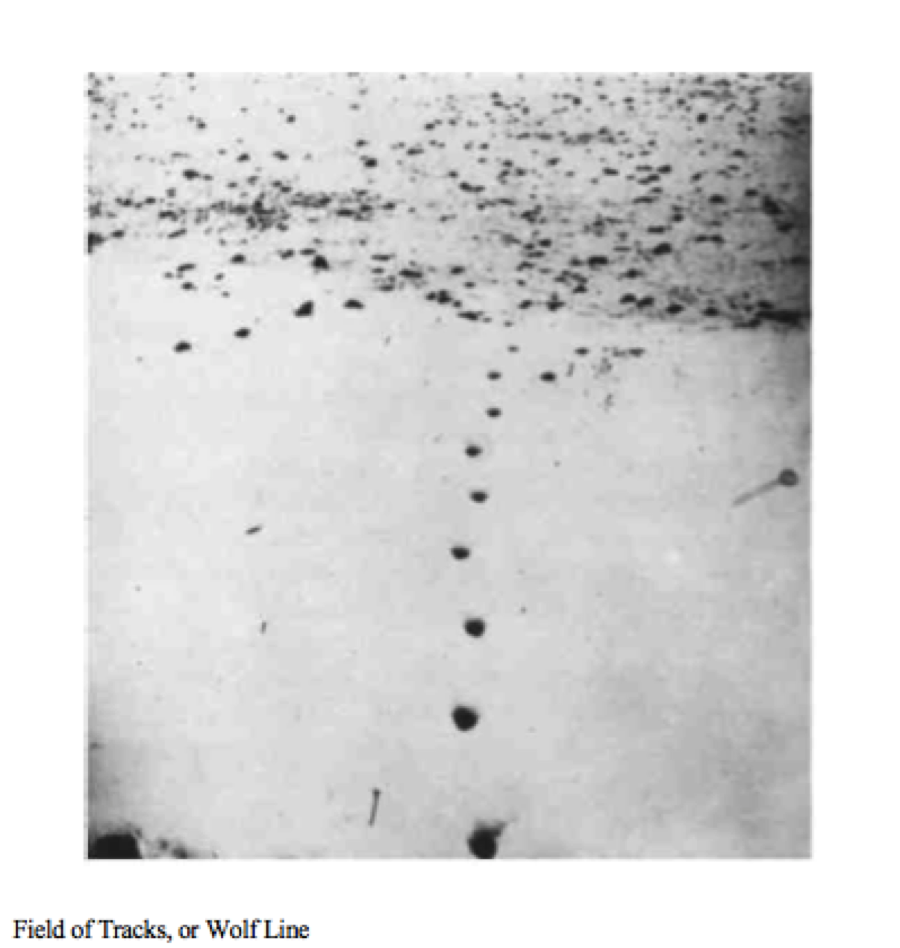
The line of flight is closely connected to the concept of the rhizome, which is described by Deleuze and Guattari using spatial terminology, “Unlike the graphic arts, drawing or photography, unlike tracings, the rhizome pertains to a map that must be produced, constructed, a map that is always detachable, connectable, reversible, modifiable, and has multiple entranceways and exits and its own lines of flight” (Deleuze and Guattari, A Thousand Plateaus: Capitalism and Schizophrenia, 1987, p. 21).
We can’t claim to understand all of D-G’s thought, which is somewhat elliptical and enigmatic by design (1,000 plateaus representing non-hierarchical levels of thought, a multiplicity, in direct contrast to traditional concepts of structure as a set of nested layers or arguments building toward a single thesis), but we also can’t help seeing the connection between the Wolf Line and the traces we see in Detroit’s shifting landscape. D-G write:
Bulbs and tubers are rhizomes… Even some animals are, in their pack form. Rats are rhizomes. Burrows are too, in all of their functions of shelter, supply, movement, evasion and breakout.
In this sense a neighborhood is also a clearly a rhizome, not a unitary, static reality, but a multiplicity of paths, trajectories, histories, structures, and potentials. Consider for example the following two images, one representing the stability of residence on the East Side, the other its transience:
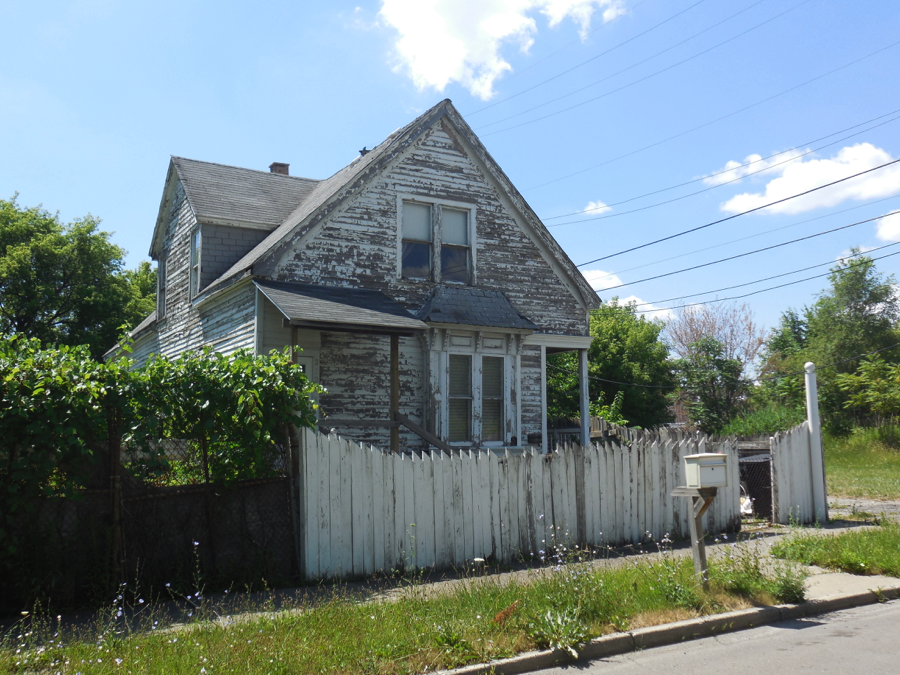
Interviewee: Now, I wanted to take a picture of that. This where the Polacks stay at.
Interviewer: Is there somebody stayin’ there now?
Interviewee: He been—yeah! Yeah. The Polack. Uh, he owned this building, and he owned this. You know? I mean, he owned this house and this right here.
Interviewer: Do you know him?
Interviewee: Huh? I’m aware of him.
For Mack, the continued presence of “The Polack” is a reminder of the neighborhood’s persistence. Even though his actual connection to him is tenuous, it retains an importance. It is something to be recorded with a photograph.
It is harder to take a picture of what has been materially and socially lost. A related photograph below was taken across the street from the house pictured above, but one struggles to place it. The fragmented sidewalk gives an indication that this is a residential area, and the presence of the invasive species phragmites australis in the foreground provides an indication of a high water table, but aside from the hands of the speaker in the lower right hander corner of the photograph there are few clues as to the social character of this space. Mack comments on this active absence, which is not a nothingness, a non-thing, but more like a memory, a ghost or a wound.
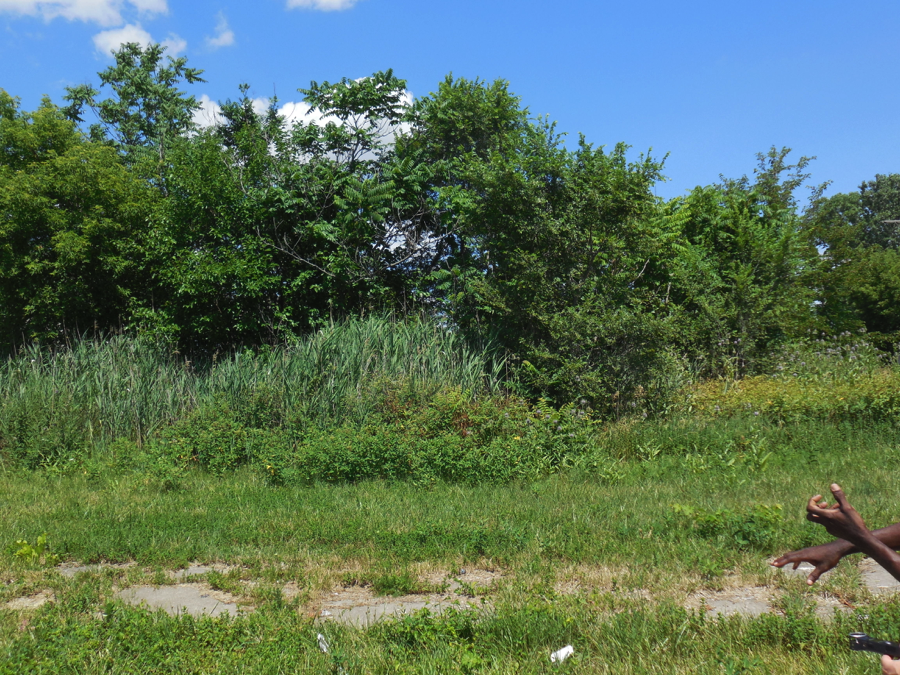
Interviewee: When you see all the empty fields out here like that, that’s why we—they called it—they called it black bottom, but it ain’t no such thing as a black bottom. Black bottom to us is like a poor neighborhood, because empty fields are empty fields. You know? Nobody—ain’t no stores out here. You have to go a mile away to go to a store, a grocery store. Ain’t no good foods out here. You got little small stores, get some hot dogs or canned foods. Somethin’ like that. Now, I’m only take you—
Interviewer: So who calls, uh—you said, uh, people call this area black bottom?
Interviewee: They call the whole black—um, the whole neighborhood black bottom now.
Interviewer: Okay.
Interviewee: Because it a poor neighborhood.
Through his narration of these adjoining spaces Mack is tracing the neighborhood’s trajectory from a Polish-dominated enclave of homes and businesses to a majority-Black community, now dominated as much by the plant population as the current human residents. Here we see a home surrounded by green growth, facing a field where the evidence of past density may be difficult to see. For Mack, the empty lot contains within it the past human occupants as well as the plants now flourishing there.
Another lot contained what might be an unremarkable monument—a single concrete planter. However, this object’s persistence rendered it worthy of remark.
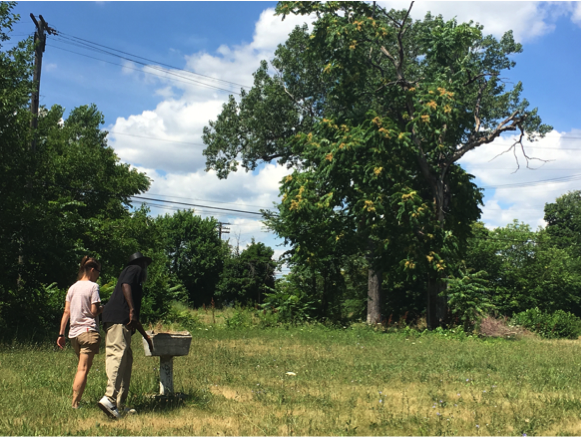
Interviewee: Now, while we walkin’ and when you see things, now, this right here was Chuck house right here. See that? This right here was—yep. A black man owned this, but his momma had died and things that happened. And I see that his momma sick, got the stone. And you can look. You can look. When we partied here in the ‘80s—and this right here. I don’t know why, and I wasn’t nothin’ but four years old, and this still standin’ here, and I’m 54. Right here?
Interviewer: Yeah.
Interviewee: Still standin’.
Interviewer: Wow.
Interviewee: Still standin’. Right here. Still—old though, but it still standin’. This right here was in the ‘80s. This was—it’s so old. It’s like, uh. It’s like, boom. It’s still standing. Nobody ain’t take it.
According to Tuan, “A neighborhood is at first a confusion of images to the new resident; it is blurred space, ‘out there.’ Learning to know the neighborhood requires the identification of significant localities, such as street corners and architectural landmarks, within the neighborhood space…” (Tuan 1977, Space and Place: The Perspective of Experience, p. 17).
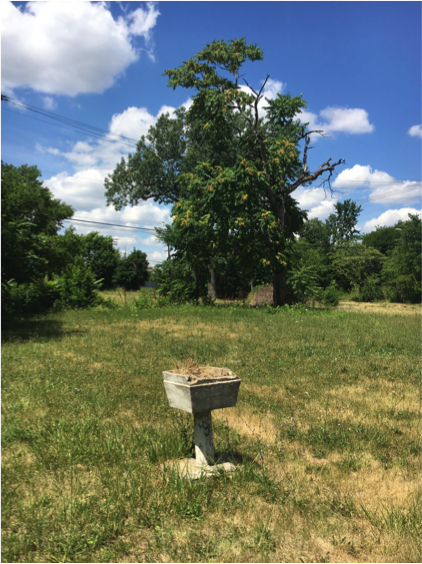
This passage reveals the constant tension between permanence and transience, between blurred space and significant localities, or using the D-G terms, between territorialization and de-territorialization. As Mack has noted, this single inconspicuous icon is significant simply because “Boom! It’s still there.”
Detroit’s fascination as a city lies not in its ruin, or reconstruction, but in the degree of play that exists between these ever-present potentialities, the struggles over identity and interpretation within these shifting fields, and the perhaps fruitless search for tipping points, clues to its ultimate outcome or meaning. Thus Detroit itself may be seen as a line of flight, unsettling because it seems so continually unsettled, a disruption of expectation, like the pheasant taking flight before our meandering feet.
In that sense, Detroit is not so different from any other city, always becoming, yet constrained by the path lain by its past, distinctive only in degree.

Photo by Tomek Zerek, taken while stomping through Detroit fields with first author
(For more on the Deleuzian perspective, see Manuel Delanda, A New Philosophy of Society: Assemblage Theory and Social Complexity.)
 Understanding Society